Xactimate Training: A Field Adjuster's Roadmap
Jul 10, 2026
By Douglas Castro, General Adjuster
If you ask most experienced independent adjusters what the hardest part of getting started was, many won't say learning Xactimate.
They'll tell you it was everything that came after.
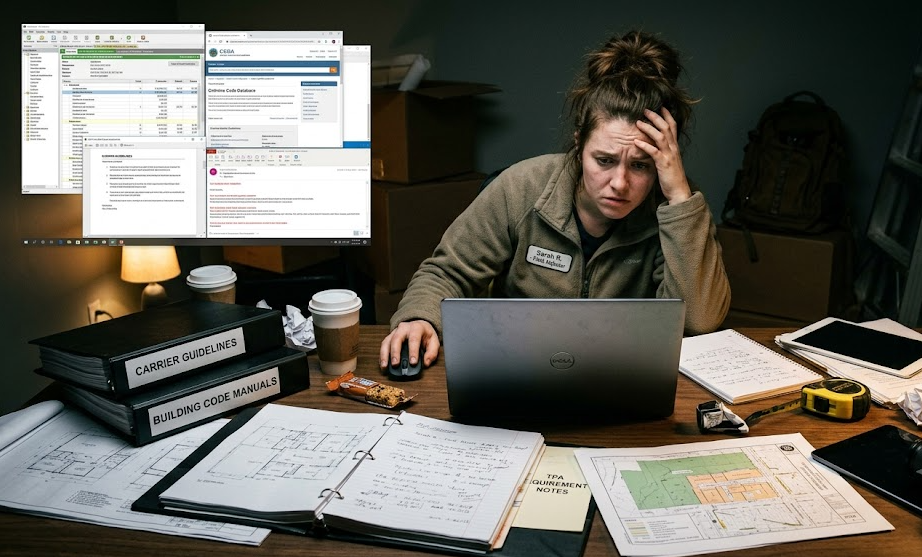
Thousands of new adjusters purchase Xactimate training every year believing that once they understand the software, they'll be ready to handle claims professionally. Unfortunately, that couldn't be further from the truth.
Learning Xactimate is like learning how to operate a scalpel. It doesn't make you a surgeon.
Likewise, knowing how to write an estimate does not prepare you for the dozens of requirements imposed by insurance carriers, third-party administrators (TPAs), building codes, manufacturer installation requirements, documentation standards, and report-writing expectations that determine whether your claim file is accepted—or returned for corrections.
Many talented adjusters leave the industry, not because they couldn't inspect a roof or write an estimate, but because they became discouraged after repeated file rejections.
The good news? Those obstacles are now far easier to overcome than they were just a few years ago.
The Myth: "Once I Learn Xactimate, I'm Ready."
Xactimate is the industry standard estimating platform for property insurance claims. It is an incredible piece of software, but it was never designed to teach you:
- How individual insurance carriers expect claims to be documented
- TPA-specific onboarding requirements
- Required photographs
- Required inspection procedures
- Building code research
- Manufacturer installation requirements
- Proper report writing
- How to defend your estimate
- How to avoid common file reviewer comments
- What should be included in F9 notes
- Why files are returned
Those skills are learned through experience. Unfortunately, experience often comes one returned file at a time.
The Hidden Curriculum No One Talks About
New adjusters often believe they'll receive extensive training after signing with a carrier or TPA. In reality, most receive:
- A deployment email
- Several PDF documents
- A carrier guideline manual
- A TPA manual
- Login credentials
- A deadline
Then they're expected to begin inspecting losses. The manuals may be hundreds of pages long, and many are written assuming you've already handled hundreds of claims.
Very little time is spent explaining why something matters, common mistakes, what reviewers actually look for, what causes delays, how to avoid supplements, or why estimates are rejected. Instead, most adjusters learn these lessons after receiving file review comments.
File Reviewers Are Not the Enemy
One misconception among new adjusters is that file reviewers are "looking for reasons" to reject files. That usually isn't true. Their responsibility is quality control.
They ensure the estimate complies with carrier guidelines, TPA requirements, policy expectations, applicable building codes, industry standards, and documentation requirements. If something is missing, unclear, unsupported, or inconsistent, they have no choice but to return the file.
Understanding this changes your perspective. Instead of asking "Why did they send my file back?" ask "How can I submit a file that already answers their questions?"
The Real Cost of Returned Claims
Every returned claim costs time. Sometimes hours. Sometimes days. Returned files create:
- Additional phone calls
- Supplemental revisions
- Estimate rewrites
- Delayed payments
- Lower production
- Frustration and reduced confidence
For independent adjusters paid per claim, every unnecessary revision reduces profitability. The goal isn't simply writing an estimate—the goal is writing an estimate that survives review the first time.
Building Codes Matter More Than Most New Adjusters Realize
One of the biggest surprises for new adjusters is discovering that writing what they physically observed is only part of the job. Building codes often require additional work that isn't obvious during an inspection. Examples include:
- Ice and water barrier requirements
- Drip edge installation
- Starter course requirements
- Ventilation improvements
- Roof-to-wall connections
- Flashing requirements
- Window and door upgrades
- Safety glazing
- Handrail requirements
Missing code-required items leads to under-scoped estimates, supplemental requests, delays for the insured, and avoidable reviewer comments. Experienced adjusters know that code research is part of writing a complete estimate—not an afterthought.
Report Writing Is Its Own Skill
Many adjusters spend more time writing reports than inspecting properties. A strong report should clearly explain the cause of loss, scope of damage, inspection observations, damaged components, undamaged areas, coverage-related observations, and supporting documentation.
Clear, professional reports reduce follow-up questions and help reviewers understand exactly what was observed. Poorly written reports often create unnecessary delays even when the estimate itself is accurate.
Experience Used to Be the Only Teacher
For decades, adjusters learned through mentors, CAT deployments, returned files, trial and error, and long nights rewriting estimates. Eventually they became excellent adjusters—but the learning curve was expensive. Today, technology can dramatically shorten that curve.
How Claims-Hub Helps Adjusters Before the File Reviewer Does
Claims-Hub.com was built from a simple idea: help the adjuster catch problems before the file reviewer catches them. Rather than replacing the adjuster's judgment, Claims-Hub acts as a second set of experienced eyes.
Claim Review
Claims-Hub reviews your estimate and highlights potential issues such as missing line items, scope inconsistencies, weak documentation, opportunities to strengthen F9 notes, and common reviewer concerns. The goal is not to generate unnecessary findings—it is to improve the quality of your file before it reaches the carrier or TPA.
Code Search
Building codes vary by jurisdiction. Claims-Hub helps adjusters research applicable code requirements that could affect the estimate, reducing the risk of overlooking code-related scope items. This is particularly valuable for experienced adjusters working outside their normal territories.
Report Writer
Professional reports consume valuable time. Claims-Hub helps transform estimate and claim information into organized, professional report drafts that can be reviewed, edited, and finalized by the adjuster. Instead of staring at a blank page, adjusters begin with a structured report that reflects the information already gathered during the inspection.
Future NFIP Support
Flood claims introduce another layer of complexity with unique documentation requirements and FEMA procedures. The planned NFIP-focused tools are designed to help adjusters navigate those specialized workflows with greater confidence and consistency.
Claims-Hub Doesn't Replace Experience
Experience remains one of the greatest assets an adjuster can have. Claims-Hub doesn't replace field knowledge, inspection skills, or professional judgment. Instead, it helps reduce avoidable mistakes by supporting the adjuster throughout the claim process.
Even seasoned adjusters occasionally overlook a line item, miss a local code requirement, or appreciate a second review before submitting an estimate. Having another layer of quality control can improve consistency without changing how you inspect claims.
Advice to New Adjusters
If you're beginning your adjusting career, remember: don't measure your success by how many files are returned. Every experienced adjuster has had files sent back for clarification or correction. The difference is that experienced adjusters learn from those reviews and continuously improve.
Master Xactimate. Study construction. Read carrier guidelines. Understand local building codes. Learn to write professional reports. Accept feedback. Keep improving. The adjusters who embrace continuous learning are the ones who build long, successful careers.
Final Thoughts
Learning Xactimate is an important milestone, but it is only the beginning of becoming an exceptional property adjuster. The real challenge lies in consistently producing complete, well-documented claim files that satisfy carrier requirements, comply with applicable codes, and withstand professional review.
The more you can catch before submission, the smoother your workflow becomes. That philosophy is what inspired the creation of Claims-Hub.com—to help adjusters submit stronger files, spend less time on revisions, and focus more of their energy on serving policyholders.
Whether you're handling your first claim or your thousandth, having reliable tools that support accuracy, efficiency, and professional documentation can make all the difference.
About the Author
Douglas Castro is a licensed General Adjuster and the founder of Claims-Hub.com. Drawing on firsthand field experience, he created Claims-Hub to help independent adjusters improve estimate quality, reduce avoidable revisions, and navigate the increasingly complex demands of modern property claims.